Pond Dipping
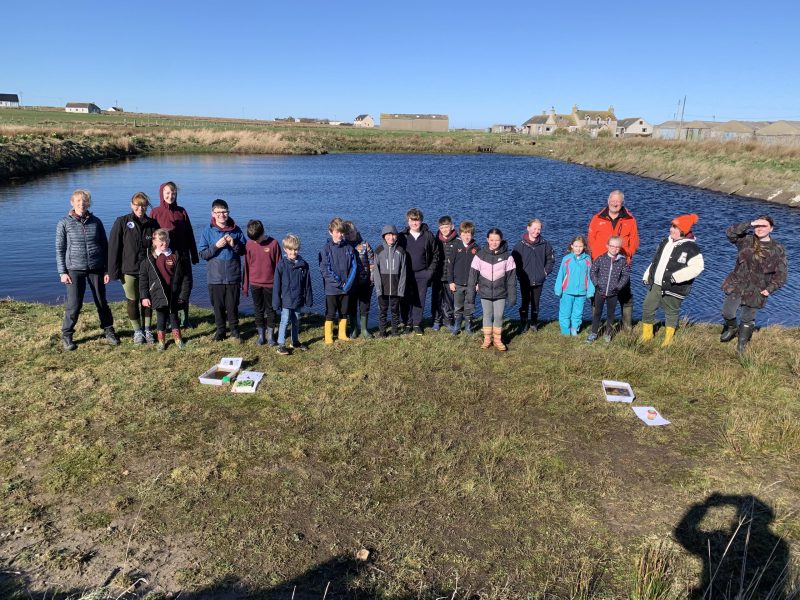
In April we invited the Caithness and Sutherland Countryside Rangers to lead a pond dipping session and other educational activities for the P4-7 pupils of Canisbay Primary School.
Catch of the Day
The pupils caught a huge variety of fish and other beasties, including:
one damselfly nymph, 33 lesser water boatman, 51 three-spined sticklebacks, six caddis fly larvae, one ‘lump’ of frogspawn, and, to the delight of the rangers one juvenile European eel.


European Eels
A 5000 Year Old Mystery
The lifecycle of European eels has long been a mystery. The ancient Greeks speculated that they were born from earthworms, while the Egyptians thought they were created by the sunbeams glancing off the surface of the Nile.
While these theories sound silly today, the truth is that the mating grounds of the European eel were only discovered by scientists in 2022, and they’re not where you’d expect!
Lifecycle
Eels usually live for around 20 years in the wild, but have been known to live for up to 80 years. During this time they enter a number of life stages, most of which were previously thought to be entirely separate species.
European eels are born in the Sargasso Sea, off the east coast of the American continent. Once hatched, they appear as tiny transparent larvae. From here they hitch a ride on the Gulf Stream to the west coast of the European continent.
By the time arrive they around 7cm long, and are known as ‘glass eels’. Some eels spend their entire lives living in these coastal waters, never growing up. Others swim upstream into freshwater rivers and burns, like our mill pond. There, the eel’s skin turns opaque brown. This is the life stage our little eel was found in.
Once larger and ready to mate, between 5-20 years old, the eels enter a process known as ‘silvering’, where increased levels of hormones change them from brown to silver, and their sexual organs develop for the first time. The eel’s final journey takes them back across the Atlantic Ocean, to spawn in the same waters they were born.

Decline of the Eel
The Caithness and Sutherland Countryside Rangers had suspected that eels were present in the mill pond; locals recall catching them by the bucketload for chickenfeed only a few decades ago.
Times, however, have changed, and the European eel has now seen a decline in populations of over 90%, earning themselves the designation of a IUCN Red List critically endangered species.
Overfishing
The reasons behind the rapid decline of the European eel are, sadly familiar. Like many aquatic species, overfishing is an problem for the eel at all stages of its life. Young European eels (once thought to be their own species, the ‘glass eel’) are a traditional delicacy in the Iberian Peninsula, and despite EU bans are still illegally caught and exported for human consumption.
The increase of hyrdroelectric dams also plays a considerable role, blocking the traditional waterways these eels once used to reach their inland homes
The Mill Pond
Our mill pond (which holds the water to power the mill’s waterwheel) was dug out and restored to its original state by the John O’Groats Mill Trust back in 2022(?), after having slowly filled up with mud and debris. The little eel caught by the Canisbay Primary pupils gives us hope that the European eel can return from the brink, just as they returned to our pond after 20 years of absence.

Acknowledgments
The John O’Groats Mill would once again like to thank the Caithness and Sutherland Countryside Rangers for leading this wonderful activity morning. We would also like to thank the teachers, parents and, of course, P2-7s of Canisbay Primary for their enthusiasm and keen fishing skills!
Share

